
In many situations, you can legally keep a gun in your car, but the rules depend on where you are, whether you have a carry permit, and how the firearm is stored. Federal law provides protection for certain interstate transportation, while each state can set additional rules for vehicle carry and storage.
Key Takeaways:
- Federal interstate transport protection has specific conditions.
- State rules can differ on loaded firearms, permits, locked containers, and unattended vehicles.
- California, New York, Colorado, and Oregon have vehicle-storage rules that deserve extra attention.
- A locked container may be required in some situations, but no single storage method makes you legal everywhere.
This article provides general information, not legal advice. Firearm laws change, so confirm current state and local requirements before carrying or storing a firearm in your vehicle.
Is it legal to keep a gun in your car?
In many situations, keeping a gun in your car is legal, but there’s no single rule that covers every driver in every state. Your permit status, loaded firearm condition, storage method, destination, and local laws can all affect what is allowed. The rules governing this question are a myriad web of different local, county, state, and federal laws that can change at the first sign of the next state, or even city, border.
A concealed carry permit may give you more options in some states, while permitless or constitutional carry laws may allow certain people to carry without a permit at all. Other states place tighter limits on loaded or accessible firearms inside vehicles. Vehicle carry laws can change significantly once you cross a state line. As attorney Charles Crain explains in his guide to carrying firearms in vehicles, “there’s no one rule to follow” because each state has its own laws.
That makes checking the law before traveling more important than relying on what was legal at home. The ATF maintains current state-law resources and recommends contacting the appropriate state attorney general when questions remain. Another great resource for current information is the State Police Firearms Division for each individual state you will be traveling through.
What federal law says about transporting a gun
The Firearm Owners’ Protection Act, or FOPA, includes a federal interstate transport provision found at 18 U.S.C. § 926A. It protects interstate travel between places where a person may lawfully possess firearms and, provided the firearm is unloaded and neither the firearm nor ammunition is readily accessible by the driver or passengers, allows you to transport your firearm through more restrictive states.
For a vehicle without a separate compartment, the statute requires the firearm or ammunition to be inside a locked container other than the glove compartment or console. FOPA is not blanket permission to carry a loaded handgun wherever you travel. It provides protection for transportation when its conditions are met, while state and local rules can still matter before, during, and after a trip.
To put it succinctly, FOPA protects the transportation of firearms through states you’re traveling through. It does not give you the ability to carry in those states.
What changes from state to state
Outside of FOPA’s safe-passage protections, state law can change what you may do with a handgun inside your vehicle. Depending on the jurisdiction and circumstances, the rules may address whether the firearm can be loaded, whether a concealed carry permit is required, where the firearm may be placed, and how an unattended gun must be secured.
Just because you have a carry permit in your home state doesn’t mean it’s valid across state lines. State laws and reciprocity rules differ, which is why your route should be checked before leaving rather than after you arrive. The same caution applies to glove boxes and center consoles. They may be permitted in some circumstances and specifically excluded in others.
Check whether the Strike fits your vehicle →
States with stricter vehicle-storage rules
Several states illustrate how different these requirements can become. California requires a handgun left in an unattended vehicle to be secured using one of the methods listed in Penal Code § 25140, including a locked container placed out of plain view or a qualifying locked trunk. California also excludes an ordinary glovebox or utility compartment from its definition of a locked container.
New York requires a firearm left outside a person’s immediate possession or control in a vehicle to be unloaded, locked in an appropriate storage container, and kept out of sight from outside the vehicle. The state’s guidance also notes that local requirements can be more restrictive. Colorado requires a handgun knowingly left in an unattended vehicle to be in a locked hard-sided container placed out of plain view, subject to the statute’s specific terms and exceptions.
Oregon requires a firearm that is not carried or under the owner’s control to be secured using an approved method, such as a locked container or engaged trigger or cable lock. An unattended handgun in a vehicle also cannot remain visible from the outside. These examples aren’t a complete state-by-state guide. Always check the current statute and any local rules that apply to your trip.
How to store a handgun in your car legally and safely
Start by knowing or learning the law where you are driving and parking. If the firearm must be unloaded, unload it. If a locked container is required, use one that meets the applicable definition of that state’s laws. When unattended-storage rules require the firearm to remain out of sight, make sure it can’t be seen through the windows. Theft prevention is always a priority even where the law gives you more flexibility with storage requirements. Anchoring your storage system to the vehicle adds another obstacle for someone who gains unauthorized access to the inside of your vehicle.
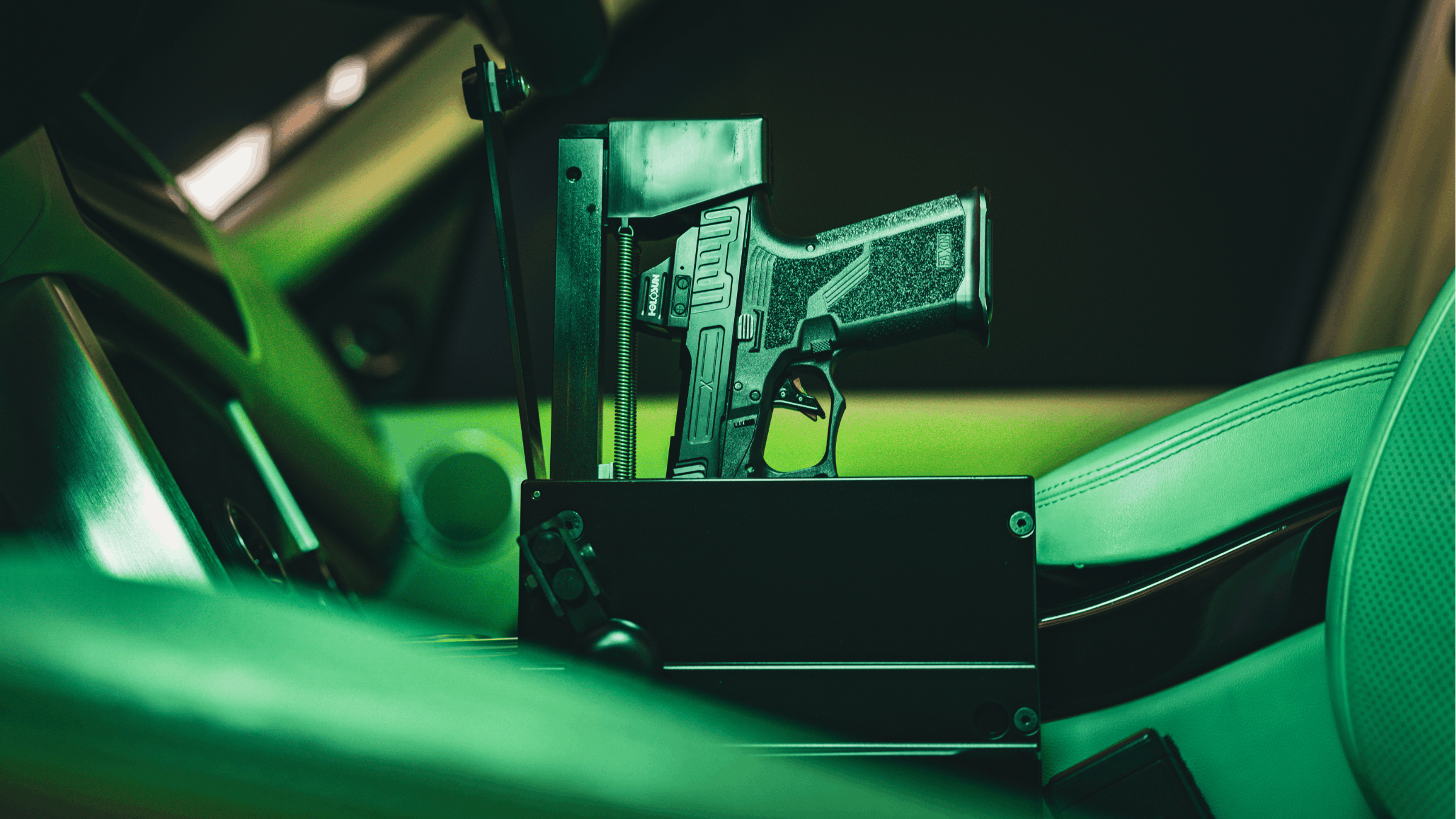
This is where the Kwick Strike can serve a valuable purpose. When you leave the vehicle and lock the Strike, it becomes a keyed mechanical vehicle vault anchored by a steel-braided security cable that can remain in between your seat and center console or can be slid underneath your seat to keep it from view when left unattended. It is built from 6061-T6 aircraft-grade aluminum and contains no batteries or electronics. Where a locked container is required, the Strike’s locked mode can provide the type of secured vehicle storage you may need, but you remain responsible for checking the exact law that applies.
See how the Strike locks a handgun down when you leave the vehicle →
Frequently Asked Questions
Is it legal to keep a loaded gun in your car?
Whether you may keep a loaded handgun in your vehicle depends on the law where you are driving, your permit status, and other circumstances. Federal FOPA transportation protection applies to unloaded firearms under its stated conditions, while rules for loaded vehicle carry are largely determined by state law. Always verify current state and local requirements before traveling.
Do I need a concealed carry permit to keep a handgun in my vehicle?
Not necessarily, because permit requirements differ from state to state and can depend on whether the handgun is loaded, concealed, accessible, or being transported rather than carried. Some jurisdictions allow permitless carry under specified conditions, while others require a license for certain vehicle carry. Check your state’s current law and any rules that apply along your travel route.
Does my gun have to be locked up or out of sight in the car?
That depends on your location and circumstances. California, New York, Colorado, and Oregon provide examples of laws addressing locked storage, visibility, or unattended firearms in vehicles. The exact requirements and exceptions differ, so don’t assume a glove box, console, or hidden location qualifies. Review the current statute before deciding how to store your handgun.
Can I drive across state lines with a firearm in my car?
Federal law provides transportation protection under 18 U.S.C. § 926A when its requirements are met. Among other conditions, the firearm must be unloaded and not readily accessible, with locked-container requirements applying to vehicles without a separate compartment. Your possession and carry must also be lawful at the trip’s starting point and destination.
Where is the safest legal place to keep a handgun in a vehicle?
There’s no single storage location that is legally correct everywhere. Depending on the applicable law, you may need an unloaded firearm, a locked container, trunk storage, or storage that remains out of sight. A locked container anchored to the vehicle can also reduce theft risk, but you should confirm the requirements for every jurisdiction where you drive through or intend to stop.
Firearm laws can change, and state or local requirements may be more restrictive than the federal baseline discussed here. Treat this guide as a starting point rather than legal advice, verify the current rules for every place you carry or travel, and speak with a qualified attorney when you need advice about your specific circumstances. When your situation calls for a locked vehicle storage, the Strike gives you a 100% mechanical option built specifically for secure vehicle use.